Description
After the outbreak of the February Revolution of 1917, Ossendowski moved to Siberia, to Omsk, where he started giving lectures at the local university. After the October Revolution and the outbreak of the Russian Civil War, he also got involved in the counterrevolutionary Russian government led by Supreme Governor Admiral Aleksandr Kolchak. He served at various posts, among others as an intelligence officer, an envoy to the intervention corps from the United States and an assistant to the Polish 5th Rifle Division of Maj. Walerian Czuma. In 1918 he was responsible for the transfer of many tsarist and White Russian documents to the Entente, including proofs (many apparently forged) of German support (confirmed later from German archives) for Lenin and his Bolsheviks (so-called Sisson Documents).
After Kolchak’s defeat in 1920, Ossendowski joined a group of Poles and White Russians trying to escape from communist-controlled Siberia to India through Mongolia, China and Tibet. After a journey of several thousand miles, the group reached Chinese-controlled Mongolia, only to be stopped there by the takeover of the country led by mysterious Baron Roman Ungern von Sternberg. The Baron was a mystic who was fascinated by the beliefs and religions of the Far East such as Buddhism and “who believed himself to be a reincarnation of Kangchendzšnga, the Mongolian god of war.” Ungern-Sternberg’s philosophy was an exceptionally muddled mixture of Russian nationalism with Chinese and Mongol beliefs. However, he also proved to be an exceptional military commander, and his forces grew rapidly.
Ossendowski joined the baron’s army as a commanding officer of one of the self-defense troops. He also briefly became Ungern’s political advisor and chief of intelligence. Little is known of his service at the latter post, which adds to Ossendowski’s legend as a mysterious person. In late 1920, he was sent with a diplomatic mission to Japan and then the US, never to return to Mongolia. Some writers believe that Ossendowski was one of the people who hid the semimythical treasures of Baron Roman von Ungern-Sternberg.
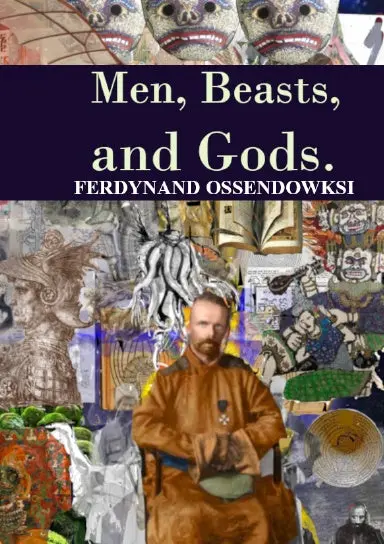
After his arrival in New York City, Ossendowski started to work for the Polish diplomatic service and possibly as a spy. At the same time, in late 1921 he published his first book in English: Beasts, Men and Gods.
Explore more from our collection.


Reviews
There are no reviews yet.